the water
Irrigation and sprinklers
Sprinkler installation and repair: control panels, broken underground pipe, failed heads, and heads re-aimed so they water the lawn and not the drive.
When the lawn tells you the water is wrong
A sprinkler system fails quietly. One patch of grass goes straw-colored in July while the rest stays green. A low corner of the yard stays soggy for days. A head throws water across the driveway and the street instead of the grass. A controller runs every zone but one. Nothing looks broken from the porch, but something underground, or in the box on the wall, is.
A.P. Lawn Care & Pressure Washing is listed on Google as a lawn sprinkler system contractor, and Yelp files the business under Irrigation, so these calls come in steadily from homes across Warner Robins and Houston County. Sprinkler and system are both among the words Google reviewers use most about the business.
A wet spot and a dry spot in the same yard are often one fault read from two sides: water leaking where it should not be, and not arriving where it should. That is why the first job is finding the fault, not just topping up the lawn.
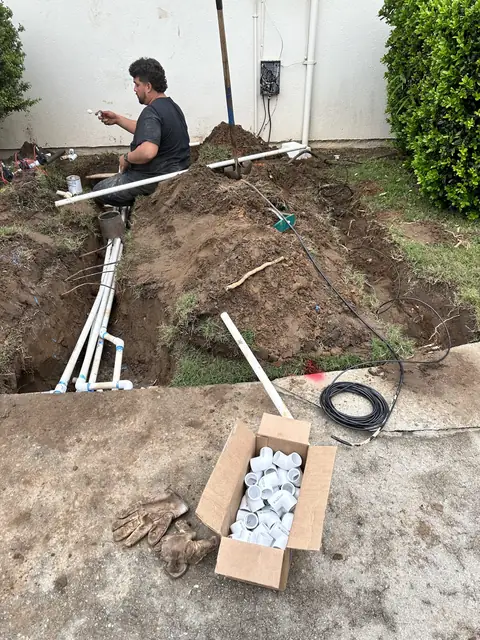
White PVC irrigation manifold being assembled in an open trench, a box of fittings beside it
Repair, from the control panel down to the heads
A repair visit starts at the controller and follows the water out. The crew confirms the panel calls each zone, then walks every zone with the water running, looking for crooked heads, geysers, and soft ground that points to a break in the line.
One repair call in January 2026 was worked the same day it came in. Three hours on site: the control panel replaced, two broken underground pipes found and replaced, four bad sprinkler heads replaced, and the heads that still worked re-aligned. That is a full repair, panel to pipe to head, finished in one visit.
New installation is the same work in the other direction. One of the crew's own photos shows a man seated in an open trench assembling white PVC into a manifold, a box of fittings beside him, valve wiring run, and a sprinkler-head marker staked where a head will sit.
Keeping every zone honest after the work
Heads get re-aligned for a reason. A head turned a few degrees waters the drive, wastes water and leaves a dry crescent in the lawn. After a repair, each zone is run again and the spray pattern watched, because a pipe fixed in one place can show a weak spot beside it.
A system is due again when the old symptoms return: the same dry patch, a zone that takes longer to come up, a low spot that stays wet, a controller that skips. The checklist below puts each sign next to what it usually means.
Anyone in Warner Robins or Houston County with a zone that will not run can call (478) 334-1049 and describe what the lawn is doing. Tell us which zone and what you see.
4.8 out of 5 from 36 Google reviews.
Signs a zone has failed
What you see on the lawn, and what is usually under it
A dry patch, a circle or crescent of straw-colored grass while the rest of the lawn stays green.
A head that is clogged, tilted or sunk, a zone that is not running, or a break upstream starving the line.
A soggy low spot that is still wet days after the zone last ran.
A leak in buried pipe. The water is going somewhere other than out of the head, and the lowest ground collects it.
A head spraying the drive, the siding or the street instead of the grass.
A head that has turned or been knocked off its arc and needs re-aligning so it covers lawn again.
A controller that will not run a zone, or will not respond at all.
A panel, wiring or valve fault. On one January 2026 repair visit, the control panel was the first part replaced.
If one of these matches your yard, call (478) 334-1049. A system that sits next to a lawn needing steady care pairs naturally with regular lawn care.