Mulch, Pine Straw, Rock, or Sod: Choosing for a Georgia Yard
The material matters less than the edge, the depth, and where it sits next to your house.
October 20, 2026 · 4 min read
A good bed does three jobs. It keeps weeds down, it holds moisture around the roots of what you planted, and it makes the yard look finished. The material you pick decides how well it does each job, and how often you have to do it again. In Warner Robins, with its heat, its humidity, and its red clay, the right choice depends on the spot more than the style. Red clay drains slowly, so a low bed can stay soggy after a storm, while a raised or sloped one dries out fast in July. Think about that before you buy a single bag.
Mulch
Shredded mulch is the all-rounder. It knits together, stays put on a slope better than loose materials, and breaks down over time into something the soil can use. That also means it thins out and needs topping up. Mulch works well in flower beds and around shrubs and young trees, and it is the easiest of the four to refresh when the season calls for it. Keep it off the trunks and away from siding, because a pile against either holds moisture where you do not want it.
Pine straw
Pine straw is a Southern standard for a reason. It is light, it lets water through easily, it settles into a loose layer that suits larger bed areas, and it gives a natural look under trees. It also moves more than mulch, so it needs a clean edge to hold against and it does best on gentle ground. Wind and heavy rain can shift it. On a steep bank it tends to slide, so another material may serve better there.
Rock
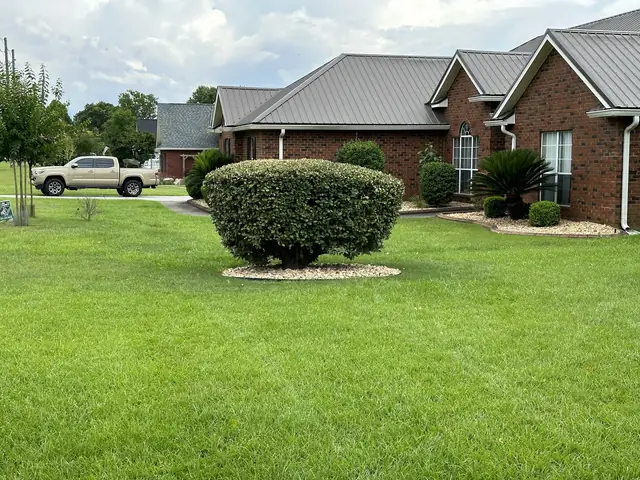
Stone does not break down, so it is a long-term choice for areas where you do not want to refresh the bed each year. One finished yard in the crew's photos shows a use for it: a sculpted ligustrum topiary sitting in a ring of stone mulch, with bordered beds of sago palms and clipped shrubs around it. A stone ring gives a plant a crisp frame, and it needs very little upkeep. The tradeoff is that stone holds heat, which can stress tender plants in a Georgia summer, and it is harder to change later. Put it where you are sure of the layout.
Sod and top dressing
Not every bare patch should become a bed. Where there is sun and foot traffic, a lawn is often the better answer, and fresh sod covers a spot quickly. Thin turf that is otherwise healthy may not need replacing at all. A light layer of top dressing over a thin or uneven lawn can smooth it, fill low spots, and give the grass a better surface to grow through. Look at the ground before deciding which one the spot really needs: how much sun it gets, how it drains after a hard rain, and how much foot traffic it sees.
- Heavy shade under trees: pine straw or mulch, since grass struggles there
- Sunny, high-traffic area: sod or a lawn repair, not a bed
- A low-maintenance frame around a feature plant: stone
- Beds along the house: a neat edge and a clear gap between the material and the siding
- A slope: mulch, which holds better than pine straw
The edge is half the work
A bed with a clean cut edge looks maintained even when the plants are modest. A bed with no edge looks neglected even when it was just refreshed. A cut edge is also a physical barrier, a small trench that keeps grass runners out of the bed and holds the material in. The crew's before-and-after hedge photos are a good example: the same shrubs, but with the hedge sculpted and the walkway edge cut crisp, the whole front of the house reads as cared for. An edge also keeps grass from creeping into the bed and mulch from drifting onto the walk.
Dan Newman, a Google reviewer, wrote that his new-construction backyard was unfinished and that Anthony "helped make our dream garden come true," finishing on time with "no surprise add ons" on the bill. That is the standard for bed work: a clear plan up front, and a finished space at the end.
Maintaining what you build
Refresh mulch or pine straw before it thins enough for weeds to push through. Pull the weeds that do show up while they are small. Keep an eye on irrigation, since overspray on a bed can leave it soggy, and drip or spray that misses it can leave plants dry. A.P. Lawncare handles flower beds, mulch, pine straw, rock, sod, top dressing, and hedge shaping around Warner Robins and Houston County. Call (478) 334-1049, and the services page lists the rest of the crew's work.
A.P. Lawn Care & Pressure Washing LLC, (478) 334-1049
Call (478) 334-1049More articles
A Warm-Season Lawn Calendar for Middle Georgia Yards
A warm-season lawn runs on its own calendar, and a northern schedule is how good grass ends up thin.
Why Your Siding Turns Green in This Humidity
The north side of the house is not cursed. It just stays wet longer than the rest.