Taking Back a Yard That Got Away From You
A season or two of neglect is all it takes. Getting it back does not mean starting over.
October 20, 2026 · 4 min read
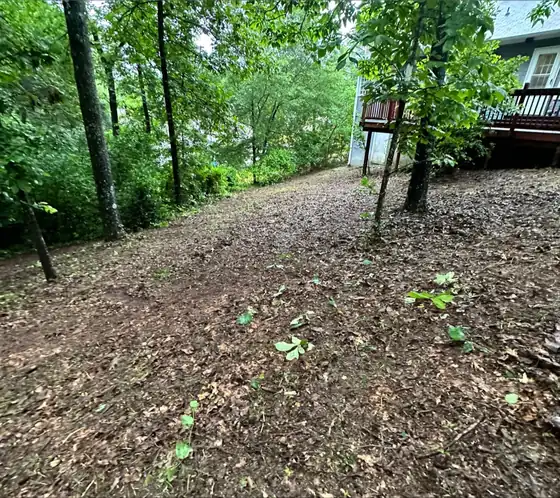
It does not take long. A new-construction lot sits through one growing season, a rental goes a summer without anyone tending the back corner, or a homeowner falls behind during a busy stretch of life, and suddenly there is a wall of brush where a yard used to be. That is not a lost cause and it is not a sign anyone did something wrong. Middle Georgia's growing season is long, warm, and wet, which is exactly why a yard gets away from people so fast.
How it happens
Once grass stops being mowed and sunlight reaches bare ground, brambles, vines, and volunteer saplings establish themselves quickly. Vines climb a fence line from a neighboring lot in a single season if nothing stops them. When brush and vine cover the ground thickly enough to block light, whatever grass was underneath starts dying off, which opens more room for the plants that never need mowing. A yard that looked merely neglected in spring can be impassable by the end of summer.
What is worth keeping and what has to go
Mature trees almost always survive being uncovered and are worth working around. Shrubs and flower beds buried under brush frequently come back once they have light again. What has to go is usually what grew there uninvited: thorny bramble, climbing vines, saplings crowding a tree's canopy, and anything growing directly against the house or a fence line where it traps moisture. The crew's before-and-after photos of a wooded lot show the result: a lot choked with undergrowth and brush on one side, and the same lot cleared back to open ground on the other.
A.P. Lawncare has cleared backyards of overgrowth, brush, and weeds, cleared debris off roofs, and taken apart old garden structures like a gazebo that had gone from a feature to a liability. One Google reviewer, Jessica Spencer, called the crew a "one-stop shop" for the outdoor work her property needed, from the cleared backyard to the pressure washed house and patio.
Why doing it yourself goes wrong fast
Waist-high brush hides more than it looks like from the edge of the yard. Fire ant mounds build up undisturbed in overgrown ground, snakes favor thick cover, and old debris, buried rocks, or a stump can wreck a mower blade or hurt someone before they see it. Brush-cutting equipment is dangerous for someone using it for the first time in dense growth, and the sheer volume that a truly overgrown yard produces is its own job. Cut brush piles up faster than most people expect and needs somewhere to go.
- Brush thick enough that you cannot see the ground from the edge of the yard
- Vines climbing a fence, a tree trunk, or the side of the house
- A section you stopped mowing because it is not grass anymore
- An old structure, pile of debris, or a shed or gazebo buried under growth
- Any area you are avoiding because you do not know what is under there
The right order of work
Order matters. Cut the brush and vines first, by hand and with the right cutting tools instead of blind mowing, so the trees and shrubs worth keeping are protected and the unwanted growth comes out at the root. Then drag the cut material onto tarps and out of the way as you go, so the work area stays clear and nobody trips on piles. Look at the ground as it opens up, too: stumps, rocks, and old debris that were hidden are easier to deal with while you can see them. Once the ground is open, what is actually there becomes obvious: healthy soil, an established shrub, a flower bed that was only buried. From there it is a normal yard again, not a demolition project.
What comes after the clearing
Clearing is only half the job. Bare soil that has been shaded for a season or more is often compacted or uneven, and left alone it will grow the same weeds again. Decide what the space is for before you finish. A lawn means grading and sod or seed. A bed means edging and mulch or pine straw. A play area or a parking pad means different ground work again. A cleared lot is a blank page, and the next step is the plan for it.
If you have a yard like this in Warner Robins or anywhere in Houston County, call (478) 334-1049 and describe what you see. Photos help. So does a rough idea of what you want the space to be when the brush is gone. A.P. Lawncare also does the work that follows clearing, such as sod, mulch, and pine straw, so the same crew can carry a yard from overgrown to finished.
A.P. Lawn Care & Pressure Washing LLC, (478) 334-1049
Call (478) 334-1049More articles
A Warm-Season Lawn Calendar for Middle Georgia Yards
A warm-season lawn runs on its own calendar, and a northern schedule is how good grass ends up thin.
Why Your Siding Turns Green in This Humidity
The north side of the house is not cursed. It just stays wet longer than the rest.